2026年物流與無人機配送管理專業最佳學習途徑:
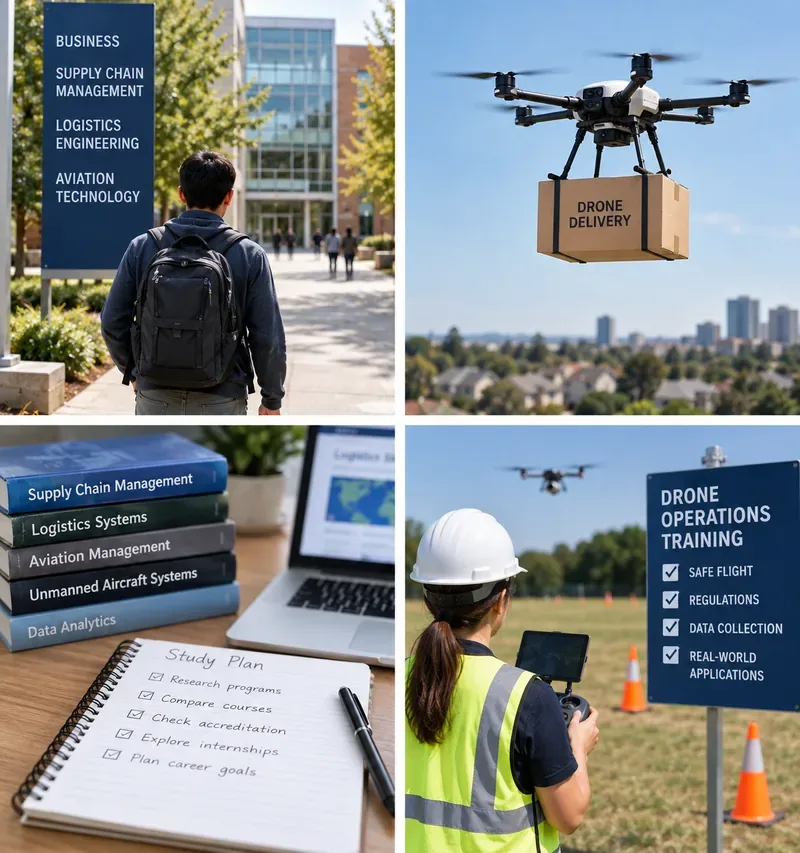
比較 2026 年物流、供應鏈、無人機系統和無人機操作等熱門學位課程,並根據職業目標提供實用建議和課程選擇清單。
“Autonomous systems engineering” is a useful career label, but it is not a standardized university degree title. A strong route into the field may be called robotics, autonomy, systems and control, aerospace engineering, electrical engineering, or intelligent machines. That naming difference matters: choosing by title alone can lead you toward a program that is excellent in one part of autonomy but light in another.
This guide compares eight university pathways using information published on official program pages and checked in September 2026. It does not claim that one institution is objectively “best” for every student. Instead, it focuses on what each program actually teaches, what type of student it may fit, and what you should verify before applying.

A credible curriculum usually combines several technical layers rather than treating autonomy as a synonym for artificial intelligence. The exact balance depends on whether you want to work on self-driving vehicles, drones, mobile robots, industrial systems, spacecraft, medical robots, or another application.
Action: Before shortlisting a university, open its current course list and mark which of these seven areas are compulsory, optional, or missing. A program does not need equal depth in all seven, but the pattern should match the kind of autonomous system you want to build.
| University | Verified program or pathway | Strong fit for | Main trade-off to check |
|---|---|---|---|
| MIT | AeroAstro graduate study with an Autonomy field | Aerospace autonomy, planning, estimation, control, safety-critical systems | Autonomy is a field within a broader degree, not a standalone “Autonomous Systems Engineering” degree |
| Carnegie Mellon | MS in Robotics (Research) | Research-intensive robotics and preparation for R&D or PhD work | Thesis/research commitment is substantial; funding is not guaranteed |
| University of Michigan | MS in Robotics | Balanced sensing, reasoning, acting, and real robotic systems | Broad robotics scope means you must deliberately build an autonomy-focused course plan |
| University of Pennsylvania | Robotics MSE | Interdisciplinary AI, vision, control, kinematics, dynamics, and prototyping | A professional MSE structure may differ from a thesis-heavy research master's |
| University of Oxford | MSc in Autonomous Robotics | A compact, explicitly autonomy-focused master's with project and dissertation work | It is an intensive 11-month program and is new for 2026-27 entry |
| ETH Zurich | MSc in Robotics, Systems and Control | Control, modeling, navigation, path planning, AI, and multidisciplinary engineering | Highly flexible study can require careful tutor/course selection |
| KTH Royal Institute of Technology | MSc Systems, Control and Robotics; Robotics and Autonomous Systems track | Autonomous mobile systems, sensing, AI, decision-making, and control | Track structure matters; compare RASM with the Learning, Decision and Control track |
| Aalto University | MSc Automation and Electrical Engineering; Control, Robotics and Autonomous Systems major | Control, automation, embedded systems, robotics, and intelligent systems | The degree is broader than robotics alone, so elective choices shape your specialization |
Verified: major universities often teach autonomy inside differently named programs. MIT AeroAstro lists Autonomy as a graduate field, while ETH Zurich offers a Master of Science in Robotics, Systems and Control. KTH offers a Systems, Control and Robotics master's with a Robotics and Autonomous Systems track.
What depends on context: the degree title matters less than whether your transcript, projects, and research show competence in perception, estimation, planning, control, software, and system integration. Employers and PhD committees can evaluate those signals differently, so there is no universal title that guarantees a better outcome.
Action: Search for program content using terms such as robotics, autonomy, control, estimation, perception, embedded systems, motion planning, intelligent systems, and cyber-physical systems instead of searching only for the exact phrase “autonomous systems engineering.”
Verified: robotics is broader than autonomy. The University of Michigan describes its robotics curriculum around three core areas: sensing, reasoning, and acting. Its MS Robotics requirements require breadth across those categories. That is valuable, but another robotics program could emphasize manipulation, mechanical design, manufacturing, or human-robot interaction more heavily than autonomous navigation.
What depends on context: a manipulation-focused student may not need the same localization and path-planning depth as someone targeting autonomous vehicles. Conversely, a computer-vision-heavy plan may leave gaps in dynamics and feedback control.
Action: Look beyond the program name. Check whether you can assemble a sequence that includes at least one serious course in perception or sensing, estimation, planning or decision-making, and control, plus a project where those components interact.
Verified: MIT's official description of its Autonomy field explicitly combines planning and decision-making with control and estimation, sensor fusion and perception, and human-robot interaction. The MIT AeroAstro Autonomy field is a useful example of why embodied autonomy is broader than machine learning alone.
What depends on context: software-only autonomous agents may rely more heavily on AI and decision systems, while drones, mobile robots, and vehicles must also obey dynamics, latency, sensing limits, actuator constraints, and safety requirements.
Action: If your target is a physical system, do not shortlist a program solely because it has fashionable AI electives. Confirm that it also teaches control, estimation, real-time computation, and system-level testing.
MIT AeroAstro offers master's and doctoral graduate study across multiple fields, including Autonomy. The department describes autonomy as embodied intelligent systems such as autonomous drones, self-driving cars, and robots, with foundations in planning, decision-making, control, estimation, sensor fusion, perception, and human-robot interaction. Graduate work includes coursework and research culminating in a thesis.
Best fit: students interested in aerospace autonomy, safety-critical systems, advanced decision-making, controls, or research that bridges algorithms and real physical vehicles.
Limit: this is not a standalone master's called “Autonomous Systems Engineering.” Your actual study plan depends on degree requirements, advisor guidance, and research interests.
行動:申請前,請先查看「自主性」領域的描述,然後檢視與您偏好的車輛或自主性問題相符的教師和實驗室工作。
卡內基美隆大學機器人研究所提供以研究為導向的機器人學碩士課程,該課程以課程學習和導師指導的研究相結合。目前的課程涵蓋機器人學基礎知識和大量的研究工作,最終成果包括一篇論文和一次公開報告。卡內基美隆大學表示,該課程通常需要24個月完成,旨在為學生從事研究工作、攻讀博士學位以及高級研發工作做好準備。
最適合:希望獲得研究密集型體驗,並且樂於將大部分學位時間用於指導研究而不是僅僅課堂課程學習的學生。
限制: CMU 表示 MSR 不提供或保證資金,因此財務規劃是決策的一部分。
行動:比較官方的機器人學碩士課程概述和MSR課程設定。如果您更傾向於產品開發而非論文研究,也請比較卡內基美隆大學的其他機器人學碩士項目,而不要想當然地認為MSR就是最佳選擇。
密西根大學機器人學碩士課程將其研究生課程描述為涵蓋硬體和軟體的自主系統技術培訓,並提供使用真實機器人系統的實踐經驗。該碩士課程要求修滿30個研究生學分,並圍繞感知、推理和行動三大核心要素建構機器人學學習框架。這種結構有助於培養自主性,因為它促使學生思考感知、決策和物理行動如何相互協調。
最適合:希望獲得廣泛的機器人基礎知識,並有機會發展成為「全端」機器人專家,而不是立即專注於軟體或機械的學生。
限制:只有當你在目標領域建立足夠的深度時,廣度才是一種優勢。
行動:在決定現有課程深度是否符合你的目標之前,請使用密西根機器人研究生概述和學位要求來製定一個假設的 30 學分計劃。
賓州大學工程學院的機器人學碩士課程是一門跨學科專業,融合了電腦科學、電機工程和機械工程。賓州大學的官方介紹將人工智慧、機器學習、電腦視覺、控制系統、運動學、動力學以及機器人系統的設計、程式設計和原型製作列為現代機器人和智慧系統的核心能力。
最適合:希望獲得專業機器人碩士學位,並廣泛接觸軟體、控制、視覺和實體原型製作,包括與 GRASP 實驗室相關的工作的學生。
限制:以研究論文為主要目標的學生應該將具體的研究機會和學位結構與以論文為基礎的課程進行比較,而不是假設每個機器人碩士課程的運作方式都相同。
行動:閱讀賓州大學工程學院官方碩士課程目錄,找到機器人學碩士課程部分,然後將必修課和選修課與你打算的專業方向進行比較。
牛津大學的自主機器人學碩士課程名稱和課程設定都非常直白。 2026-2027學年,牛津大學開設了一個為期11個月的全日制項目,專注於自主機器人系統,包含六個核心模組、一個機器人實踐小組項目和一篇畢業論文。課程內容涵蓋程式設計、感知、系統工程、機器學習、路徑規劃、地圖建置、狀態估計、模擬、控制和硬體實作等主題。
最適合:希望獲得集中、以自主學習為重點的碩士學位,並且能夠適應為期一年的密集型課程結構的學生。
限制:該計畫於2026-2027學年新設立,因此尚無較長的畢業生就業記錄。截至2026年9月13日,2026-2027學年的入學申請已截止。牛津大學表示,大部分2027-2028學年的課程預計將於2026年9月16日開放申請。
行動:在計畫申請之前,請立即查看牛津大學自主機器人學碩士課程的即時頁面,因為截止日期、費用和申請狀態都具有時效性。
蘇黎世聯邦理工學院的機器人、系統與控制碩士課程融合了機械工程、電機工程與電腦科學。官方課程概述包括機器人設計、建模與控制、系統工程、物理建模與模擬、最佳化與控制、感知、導航與路徑規劃、嵌入式與分散式運算以及人工智慧。
最適合:希望在機器人、自動駕駛汽車、控制和智慧機器等領域保持靈活性的同時,擁有紮實的數學和系統基礎的學生。
限制:靈活性意味著你不應該只根據課程的廣泛主題清單來評判一個專案;你的成果品質很大程度上取決於你選擇的課程、導師、專案和論文。
行動:首先造訪ETH 機器人、系統和控制的官方頁面,然後查看你想要學習的特定領域目前的課程設定和潛在的導師。
瑞典皇家理工學院(KTH)的系統、控制與機器人學碩士課程為期兩年,學分為120個歐洲學分(ECTS),設有機器人與自主系統方向。 KTH將此方向描述為專注於自主移動系統,例如機器人、無人機和自動駕駛汽車,並運用複雜的感測器和方法進行感知、規劃、決策、人工智慧、機器學習和控制。該項目還提供學習、決策與控制系統方向。
最適合:希望在強大的控制和系統框架內獲得明確自主學習路徑的學生。
限制:這兩個方向有所重疊,但重點不同。選擇與自身目標不符的方向,其影響可能比大學名稱本身更大。
行動:比較KTH系統、控制與機器人碩士課程概述和當前課程清單。 KTH列出的2027年8月入學申請開放日期為2026年10月16日,因此請在提交申請前再次確認截止日期。
阿爾託大學的自動化與電機工程碩士課程包含控制、機器人與自主系統專業方向。 2026-2028年的課程設置涵蓋了以控制工程和自動化為基礎的多學科交叉領域,並可選擇機器人、智慧系統、工廠自動化、工業軟體及相關領域的專業方向。該碩士學位總學分為120個歐洲學分(ECTS),其中專業課程佔65個學分,論文佔30學分。
最適合:希望在控制、自動化、嵌入式系統和工程軟體方面獲得自主性,而不是僅僅專注於機器人技術的學生。
限制:因為學位涵蓋了多個自動化方向,所以選修課和論文決定了你的最終職業規劃在機器人技術或自主技術方面的重點。
行動:查看阿爾託大學自動化與電機工程碩士課程頁面及2026-2028年課程設定。如果您想要一個更明確專注於自主系統方向的專業,也可以比較阿爾託大學的EIT數位自主系統與智慧機器人方向。
一所大學整體水準可能非常優秀,但未必適合你特定的專業方向。比較不同課程的一個實用方法是,根據你希望畢業時達到的成果來評估它們。
| 你的目標 | 需要尋找的證據 | 警告標誌 |
|---|---|---|
| 自動駕駛汽車或無人機 | 狀態估計、控制、運動規劃、感知、車輛動力學、現場測試 | 主要都是人工智慧課程作業,缺乏動態性和控制性。 |
| 移動機器人 | SLAM/定位、導航、規劃、感知、嵌入式或即時系統 | 沒有實質的整合機器人項目 |
| 研究或博士學位準備 | 論文、在教師指導下進行的持續研究、出版或研究研討會 | 僅包含短期課程項目,沒有深入研究的途徑 |
| 產業產品開發 | 團隊專案、硬體/軟體整合、系統工程、實習、部署 | 理論雄厚,但實踐不足 |
| 面向具身系統的AI | 機器學習加上感知、估計、規劃、控制和即時約束 | 人工智慧課程脫離物理系統 |
| 控制與安全關鍵型自主性 | 非線性/最佳控制、估計、驗證、穩健系統、形式化方法 | 小數學系統訓練 |
行動:每個入圍項目0到2分的評分,評分標準包括課程匹配度、研究匹配度、實踐機會、論文/項目形式、費用/資金以及地點/簽證便利性。如果某個知名項目匹配度分數較低,通常提示需要考慮其他選擇。
如果你發現你以為可以選修的課程在你入學那年並沒有開設,你希望合作的院係不招收學生,學位課程設置與你的研究或行業目標不符,或者總費用不切實際,那就應該改變方向。這些並非無關緊要的細節;它們會決定你最終能學到什麼,以及你能帶走什麼樣的作品集或論文。
如果你無法找到至少一條從課程學習到綜合計畫或研究經驗的具體路徑,也應該重新考慮是否選擇該課程。自主系統本質上是系統問題。雖然學習一些互不相關的AI、機械和控制課程可能會有所幫助,但檢驗你是否真正具備相關能力的最佳方法通常是,在實際約束條件下讓這些組成部分協同工作。
行動:在繳納申請費之前,請為每所大學撰寫一份一頁紙的「學位計畫」:包括五到八門課程、一個專案或實驗、可能的論文/研究方向(如適用),以及您期望在畢業時展現的技術技能。如果您無法根據現有官方資訊制定一份令人信服的計劃,請繼續研究或選擇其他項目。
官方網站可以核實學位結構、已公佈的課程、既定的學習成果和當前的申請規則。但它們無法保證您畢業後一定能獲得特定的導師、研究主題、實習機會、實驗室實習職位、獎學金或工作。課程安排和教師授課情況也可能在申請和入學之間發生變化。
這種不確定性對於研究型項目尤其重要。一所大學可能擁有卓越的自主系統研究,但你能否參與其中取決於研究能力、招生決定、資金、導師匹配以及專案時間表。
行動建議:將大學官網作為第一層核實依據,而非最終依據。對於你最心儀的兩到三個項目,務必直接聯繫項目官方招生部門或學術聯繫人,確認當前的課程設置、研究小組參與規則、論文要求以及資助情況。
如果您想要一個明確的自主性方向,牛津大學的自主機器人學碩士課程、皇家理工學院的機器人與自主系統方向以及阿爾託大學的控制、機器人與自主系統專業,從專案結構上就能輕鬆辨別。如果您追求研究深度,卡內基美隆大學的機器人學研究型碩士課程和麻省理工學院航空航天系的自主性領域值得重點比較。密西根大學和賓州大學提供廣泛的跨學科機器人學途徑,而蘇黎世聯邦理工學院則提供特別全面的系統與控制框架。
更恰當的問題不是“哪所大學排名第一?”,而是“哪個項目能讓我畢業時掌握我所需的自主學習能力、項目經驗和研究成果?” 請參考最新的官方課程設置來回答這個問題,並在申請前再次確認有時效性的招生信息。
比較 2026 年物流、供應鏈、無人機系統和無人機操作等熱門學位課程,並根據職業目標提供實用建議和課程選擇清單。
Compare autonomous systems, robotics, and control programs at MIT, CMU, Michigan, Penn, Oxford, ETH Zurich, KTH, and Aalto, with practical selection criteria.
A practical FinTech cybersecurity guide to protecting financial data from account takeover, API abuse, ransomware, third-party risk, and modern fraud.
電網級電池正成為再生能源的核心靈活性工具。看看它們的優勢和不足之處,以及2026年的數據會如何顯示。
CRISPR技術現已獲準用於治療癌症。了解哪些方面已被證實有效,哪些方面取決於疾病和給藥方式,以及關於基礎編輯和起始編輯還有哪些未知之處。
See how continuous processing, platform technologies, PAT, digital twins, and modular manufacturing are accelerating reliable therapeutic production.
探索工業 4.0 智慧自動化如何結合人工智慧、數位孿生、工業物聯網、邊緣控制和標準,在不取消必要的人工監督的情況下提高效率。
具身人工智慧將基礎模型從文字轉化為實際動作。了解為什麼機器人技術、超大型陣列、模擬和安全技術使其成為科技的下一個前沿領域。
了解銀行和支付服務提供者如何利用人工智慧、行為訊號、網路分析、規則和人工審核來即時阻止詐欺行為,同時又不影響正常客戶。
碳捕獲專案如何獲利,工程成本體現在哪裡,以及 2026 年的政策、儲存中心、稅收抵免和合約如何影響融資能力。